Archive for March, 2009

Excellent advice to improve your writing productivity

Posted in On Writing  by John Brown on March 31st, 2009

I have found every one of Maya’s practical prescriptions to work for me.

Tags:

For your epic enjoyment

Posted in Zing  by John Brown on March 31st, 2009

On Writing Excuses someone talked about writing an epic fantasy in a limerick. I figured I’d give it a go. Of course, it’s a slight cheat, but epic nevertheless.

A tiny man with a ring
Said I’ll save the world from this thing
He traveled to Mordor
But in very short order
Was trounced by the chatty bling bling

More info on the American Fork Arts Council Gig

Posted in News - updates on books, events, appearances, etc., On Writing  by John Brown on March 30th, 2009

Fat head alert.     

Not to be missed – the most useful speech on writing you will ever hear! Keynote speaker John D. Brown will present ‘Three things you MUST know to write killer stories.’ John Brown is a prize-winning short story writer and novelist. His epic fantasy novel, “Servant of a Dark God” will be released in North America in September 2009. 

“Most useful” is nice. Let’s hope I can live up to that one.  :) I’m looking forward to this event. A lot of other great authors will be there as well as editors from Deseret Book, Covenant, and Cedar Fort. If you’re a regional writer, you won’t want to miss this. Full information here on the American Fork Arts Council council for writers.

The Face of Mechanical Genius

Posted in Zing  by John Brown on March 27th, 2009

This is Warren Ellis.

I heat my house with radiant heating. When we built this place, Nellie, I, and the girls laid down yards and yards of tubing. Then the mudmen came in and covered it all up with concrete. We run hot water through that tubing. That water it heated by a boiler, which also heats the water for sinks and showers.

About two and a half weeks ago our boiler quit working. We called the guy who sold it to us. It worked again for one week and went out again. Then again. And again. Now if we lived in the valley and it was summer it wouldn’t be an issue. But we live at 6,000 feet, in the mountains, and it’s winter. We just got four inches of snow two days ago. Needless to say, heat is important.

Well, four technician visits, $600, and many hours later, we still have problems. The blasted boiler conked out again tonight just as Nellie and I were about to take showers to go to a dance for adults our church was putting on.

So we brought in the big guns. We called Warren. Now Warren fixes cars. He fixed our fridge. He’s worked on everything from computers to furnaces. So Warren arrives. In less than 10 minutes the @#!$ boiler was working again. And we now know exactly what the problem is so the Lochinvar boiler rep can’t tell us to look for something else and that it’s an installation error (yes it’s a Lochinvar Knight boiler–remember that boiler buyers). Genius. Absolute genius.

I offered to give Warren a big old kiss–hey, hot water’s important, almost as important as a wife who doesn’t have to take a cold shower in the morning. Warren refused. 

So here’s a wet one for ya, Warren. You’ve done your work to further world peace.

Tags:

Where the Wild Things Were by William Stolzenburg

Posted in John's Reviews - books, movies, whatever  by John Brown on March 27th, 2009

I live among ranchers in northern Utah, people whose livelihood walks around on four legs. People who can lose thousands of dollars of future income if they lose one good cow or calf. People who think one of the dumbest things to happen in recent times in the West is the reintroduction of wolves to Yellowstone. Now, I don’t agree with them, but I do think they have good cause.

Contrary to what people will tell you, wolves do not kill just for food. Wolves kill because they like killing. If you don’t believe me, then believe Temple Grandin, an expert on animals, who asks the question in her Animals in Translation: “Is it fun to kill a groundhog?” 

She reviews a number of studies done on animals and answers with an unequivocal yes, predators love to kill. In fact:

“Animals like having their predatory killing circuits turned on, and will turn them on themselves if you show them how. When you think about what predatory killing is all about, of course it ought to feel good, because predatory killing means dinner. Killing a mouse feels good to a cat the same way finding a luscious ripe banana feels good to a primate.” (p138)

What this means is that when wolves come to kill sheep, they don’t just kill one old and decrepit ewe. No, they do what they did on a neighbor’s land a few miles from my home. They maim and kill five or six. Not because two wolves were that hungry, but because it was fun and they could.

Sheep are like popcorn to wolves. Compare them to elk or other wild animals. The reason why wolves tend to indeed eliminate the young, weak, and old in the wild is that those poor specimens tend to run a bit slower than their brethren. In the wild, slow means dead. For the wolf, it’s hard work to run down an elk or buffalo. And if you’re a hungry son-of-a-gun, you’re not going to go chasing after another dinner while there’s fresh meat in front of you because the rest of the pack will eat it before you get back. And you ain’t going to catch one on your own anyway. But sheep aren’t elk. Cattle aren’t elk. They’re bred for meat, not sprinting. Sheep are easy meat. And the wolves can’t help themselves.

But even if the wolves exercise restraint and eat just one, that’s cash. That’s clothes for the kids. That’s a mortgage. That’s heat. And it’s a danger for children as well (adults I don’t worry about: who cares about a few devoured adults?). My girls like to hike. And while I’m sure wolves will usually stay away, a sick or starving wolf will risk humans just as sick and starving mountain lions do. You get a different mindset about predators when you live up where I do. When they’re not something you see caged up in the zoo or on PBS.

For all these reasons and others, I couldn’t wait to read Where The Wild Things Were by William Stolzenburg. Folks, the book is fabulous–well-written and interesting from page one to the very end. The key point is that predators play a huge role in maintaining a healthy diversity of both plant and animal life in any given ecosystem. Stolzenburg begins with starfish and moves through otters, killer whales, jaguars, mountain lions, and wolves. Along the way he reveals just how important killing is.

Yes, killing is critical to life as we know it.

Because without it, the most dominant herbivores will end up eating all the food. And this will end up killing off most of the other herbivores. It will kill off the great variety of flora in any given system. It can turn a paradise into a hell as Stolzenburg illustrates with the islands of Lago Guri in Venezuela. 

Of course, some people think the answer is to bring back all the big predators. The rewilding supporters want to populate the West not only with wolves, but also lions (African), jaguars, cheetahs. Heck, they salivate at the idea of giant Pleistocene bears that can run faster than a horse (yeah, I want one of those up where the Boy Scouts camp).  I think it’s good the wolves are back in Yellowstone. But I don’t want packs of wolves eating my friend’s herds and daughters (of course, maybe a few Boy Scouts are okay). Still, I believe there has to be another alternative. What that is I don’t know. But we all need to think about it. We do. And great way to start is by reading Stolzenburg’s book.

Tags: , ,

Servant of a Dark God on Sale?

Posted in News - updates on books, events, appearances, etc.  by John Brown on March 22nd, 2009

Okay, okay. So I knew you could pre-order stuff, but I just never expected to see MY BOOK available 6 MONTHS EARLY! Target has Servant of a Dark God up for sale. It’s up on Amazon as well. I’m getting so excited.

Tags:

How Inequity and Deservingness Propel Readers Through Story

Posted in On Writing  by John Brown on March 20th, 2009

Inequity and deservingness are two of the main factors that keep readers reading. If we want to write killer stories, we need to know how they affect readers. A few years ago I wrote an essay on this and thought it probably too technical for most folks’ taste. But I passed it on to a recent attendee of the killer workshop and he found it helpful. In fact, when he watched Pride & Prejudice shortly after reading the essay, he saw how these factors dramatically affected his rooting interest. So I’m thinking others will find it useful as well. 

In order to understand it you must first read George Saunders’ short story “The Bohemians.” You’ll find it here in The New Yorker, January 19, 2004. It would probably be rated PG for some profanity.

Now if the story doesn’t pull you in, stop reading. Because the essay probably won’t make any sense to you. You’ll only be able to understand it if the story works for you. But if it does, then ask yourself what the main character’s problem was and what drew your interest? Then read my essay, “How Inequity Evokes Reader Interest.”

Please note ”The Bohemians” does present a character with a problem, and the story cycle applies, but not in the straight-forward manner it does to most stories. BTW, if you’ve ever read Patrick Rothfuss’s excellent Name of the Wind, you’ll see inequity is what shapes the story there as well. If you haven’t read it, I recommend you give it a go.

I’ll be interested to see your responses to Saunders’ story, my essay, and/or Rothfuss’s novel.

Tags: ,

Servant of a Dark God galley edit finished

Posted in News - updates on books, events, appearances, etc.  by John Brown on March 17th, 2009

I just mailed my galley edits off to Stacy. My baby is now out on her own. And whether she sinks, swims, or squishes is largely out of my control. I’m excited and anxious. Here we come September 15th!!

I’m wishing I could do one last story edit. But I suppose that’s just par for the course. I’d be doing story edits until the fulness of times. I’ll just have to take what I have and will learn from this one as it plays with audiences and roll it into the next. I’m going to be very interested to see how this plays.

I also just saw the map. It’s very nice. Love the style. I’ll see if I can’t post it here.

And I got an estimated publication date–September 15th. I found out there are two dates, actually. A shipping or release date when the books start leaving the warehouses. And then the date (publication date) when they estimate (a few weeks later) the book will be in stores. The book should be in stores on the 15th.

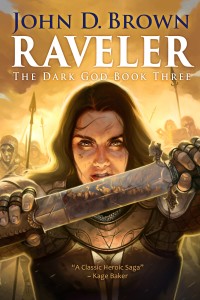
I expect the cover to be out soon as well. I told my agent I’d try to work in a big-bosomed blond into the series just in case. Not because she’s particularly fond of well-endowed ladies, but because she told me about another author’s book about a Hispanic woman with an initial cover that depicted this Hispanic woman as a blond with mucho clevage, toting a big sword (just to be clear, it was the blond toting the sword, not the clevage). Hey, miscommunications happen. I don’t know which publisher it was with, and to the departement’s credit, they were able to revise. Still, I thought I’d be ready.

And now back to book 2 in the series.

Tags:

Free audio version of “Bright Waters” available April 7th!

Posted in News - updates on books, events, appearances, etc.  by John Brown on March 12th, 2009

Mark your calendars. Just got word from the folks at PodCastle. The audio version of “Bright Waters” is set for release on April 7th! You’ll be able to get it then. Remember: Everything on PodCastle is free.

Again, this is my story about a fearsome Dutch trapper, a spunky Irish woman stolen as a girl in an Abenaki raid, and a small Iroquois tattoo…

Just go to the PodCastle site. Enjoy!

Tags: ,

Literary reading rates on the rise

Posted in On Teaching, On Writing  by John Brown on March 11th, 2009

What great news!!!

Washington, D.C.For the first time in more than 25 years, American adults are reading more literature, according to a new study by the National Endowment for the Arts. Reading on the Rise documents a definitive increase in rates and numbers of American adults who read literature, with the biggest increases among young adults, ages 18-24. This new growth reverses two decades of downward trends cited previously in NEA reports such as Reading at Risk and To Read or Not To Read.

Adults up 3.5%, young adults (ages 18-24) up by 9%. Full article here. Full report here (with nifty graphs and tables).

They attribute it to reading programs. Perhaps. I’m sure JK Rowling phenomenon had something to do with it. Whatever the reason, it’s good to hear.

Tags: ,