Archive for August, 2009

How many copies do average authors sell?

Posted in On Writing  by John Brown on August 29th, 2009

I posted earlier about the sales number for best-selling authors. What about the average author?

Here’s Patrick Nielsen Hayden, an editor at Tor Books, in an interview on io9.com about the future effects of e-text on publishing:

io9: Does it make a difference to you if an author has an online reputation? Does that go into your decisions to acquire books?

PNH: Obviously it makes a difference if an author has a public online profile of some sort, even just down to the level of having a moderately popular blog. Most books sell 5, 10, or 15 thousand copies. Most are midlist books. With those people, even a modest online presence can make a difference in sales.

The whole interview is interesting. In fact, he says something that I think is important to note about what today’s novelists and, to a lesser degree, short story writers are actually providing:

One thing I’m sure of is that we’re [Tor Books] going to be in linear immersive narratives that produce the reading trance. We won’t be moving towards a “choose your own adventure” thing. People will do those things, but those are different art forms. There’s something about immersive text that you can read in order – it’s persisted through many technological changes. This fiction stuff works pretty well. It’s been around a long time

I think he’s right. The EXPERIENCE you get in the reader’s trance, similar to the one you get in a movie, is a strong experience. The media used to convey that experience doesn’t really matter as long as it makes it easy to get into the trance.

Check out the whole interview.

Tags: , , , ,

In writing, profanity is a tool, but not the only tool

Posted in On Writing  by John Brown on August 25th, 2009

In this week’s Writing Excuses comments, a poster named Sam asked:

How do you, as writers, get past your own inhibitions concerning the use of profanity in order to write a character who does use it?

Why get past them?

Any given audience has values (as do you as a writer). Stomp on the values too much and you will make the readers so uncomfortable or angry that their discomfort will outweigh the draw of the story. They will put you down and never read you again. For one audience it’s gore. Another it’s explicit sex or vulgarity. For another it’s the bashing of a political stance or a particular demographic.

If you or your audience is uncomfortable with profanity then say “he swore” OR find another way to convey the information the profanity does.

Writing works by evoking types in the reader’s mind (as well as type resistors for surprise, curiosity, humor, etc.). Trigger a type and all the data associated with that type comes with it. Profanity is one way to trigger a type (or work against type) in the reader’s mind. But there are many other ways to evoke that same type, many ways to produce the same effect. Language, especially profanity, is a powerful and efficient method, but it’s not the only one.

You want a mean cruel man? You can have him call his wife a “cu**” all the time. OR you can just show him doing something cruel to her or slapping her, e.g. he grabs her by the neck and makes her look at the food on his plate up close like some pet owners do to dogs when they crap where they shouldn’t–”Does that look like beef stroganoff to you? Stupid whore.”

Look at Prison Break. Teddy needed to be scary. Profanity could have helped trigger his character. After all, cons use a lot of profanity. But Prison Break was prime time so the writers used other things to evoke the types they needed. Teddy worked for the purposes of that story. All of the cons did. They were believable. And all that without a deluge of profanity.

Stay away from replacement profanity that evokes a different type. For example, if you had Teddy using “darn it” all the time, unless it was part of some particular character attribute, it would have not been believable because it evokes the wrong type, e.g. Ned Flanders.

So if you don’t want to use profanity, don’t. Think about your objective and find another type trigger.

Tags:

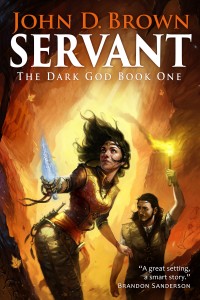
Final Cover for Servant of a Dark God

Posted in News - updates on books, events, appearances, etc.  by John Brown on August 24th, 2009

Shiny.

They moved the David Drake blurb to the side, lightened the lettering and moved things so the title wasn’t covering the top of Hunger’s head. At first I thought they moved the lettering, but they didn’t. It appears the shrunk Hunger a bit so we could see more of him. Small changes, but I think they make a significant effect. I think the overall effect is better. I like how Hunger looks more menacing in this one. Sugar is different. Don’t know which version of her I like better. I’m leaning to the original. Your thoughts? Either way, we luvs Tor’s art and production department. Here’s the before and after.

ServantDarkGod_compSODG_hb_final_cover

Tags: ,

Epigenetics

Posted in Zing  by John Brown on August 21st, 2009

Our genes aren’t in charge.

Yes, you say, of course. There’s environment and choice; both of these affect what we become. 

But I’m not talking about being in charge at that level. I’m saying that our genes aren’t even in charge of themselves.

What?

We all know that computer hardware (processor, RAM, motherboard, etc.) is important, but that the software that runs the show. Well it appears that our genes are like the hardware. Something else runs the show.

That something else is our epigenome, our epigentic tags (“epi” meaning just above as in “epidermis” or “epicenter”). The tags are chemicals that turn particular genes on and off, telling cells what they’re supposed to be–liver, skin, brain.

Furthermore, researchers think they the tags can change through a number of means, including what we eat. For example, you can take two identical set of genes for hair and, with tags, change hair color.

Research has also shown the epigenome can be passed down to posterity. So what you eat and its effect on you can be passed down to your posterity. Likewise, what you are is what your parents and maybe grandparents ate.

Genes are only a part of the story.

Holy heck, this is so cool. Watch the 12 minute video now.

Tags: , , , ,

How to tell an author you don’t like their book

Posted in On Writing  by John Brown on August 20th, 2009

Mette Harrison wrote a blog about how various authors respond when they read a book, don’t like it, and then the book’s author asks them directly what they thought of the book. 

Here’s my response.

As an author when I ask someone, especially another author, about their experience with my story, I’m looking for a data point to see how the book’s working or to get some insight. I realize others might be looking for validation. And, of course, I hope that everyone who reads my stuff finds nirvana even if I know that is not going to be the case. But I don’t ask unless I want data. And so I would hope they would report their experience accurately. I also hope they do it in friendly and helpful manner.

So because that’s what I want, that’s what I try to do for others.  And the sandwich+ method has been one good way for me to do that.

1. State something specific that works for me, e.g. “I love your character Bill because he’s so outrageous.”
 
2. State the key thing that’s giving me trouble. For example, I might say, “I am having a hard time with the pacing.” But then I ALWAYS want to give the context of me as reader when it applies to my reaction, e.g. I’m a terribly impatient reader, I like to feel hope in what I read and know I don’t like as much despair as many other readers do, I can’t stand clowns (this is true: clowns are some of the scariest creatures out there, second only to crocodiles). The author should know these readerly things when they apply so the author can understand where the comments are coming from.

If the book’s in pro shape and I think the issue is mostly my tastes, then it’s also useful to compare their work to another successful piece or author that had the same issue for me, e.g. “This reminds me of Twilight; I know people love it, but I just couldn’t get into that book either for the same reason.”

I don’t think this is fluff. I think it’s part of being accurate. Our reality is what we focus on. And if I make a statement that leaves an author thinking I think the work is bad, then that’s not accurate because the truth is I think I’m not in the audience.

If I think it’s a craft issue, then I highlight the main thing I think is causing the problem. A laundry list is usually useless. But thoughtful focus on the key issue can be very helpful. If I can’t tell whether it’s a taste issue or a craft issue, I admit it.

3. State something else that’s working for me, e.g. “While I just couldn’t get past all those clowns freaking me out, I did think your chapter openers were compelling. I always wanted to read more, but then, alas, clowns.”

4. The + is not just leaving statements hanging. Asking some sincere questions after demonstrates my genuine interest. And I am interested. If the book is unpublished, I might ask about their plans for the book, are they going to be doing another draft or shopping it, or if my reaction is common. If it’s published I might ask how it’s being received, what others are liking about it, and what’s next.  Maybe they tell me about another project they’re working on that sounds fascinating.

This is what I’d want an author to do for me–be accurate, interested, and friendly. In such a context, someone having issues with a story is not such a big deal. It really isn’t.

Tags: , ,

New Reviews for Servant of a Dark God

Posted in News - updates on books, events, appearances, etc.  by John Brown on August 19th, 2009

Here’s what a few reviewers have to say about Servant of a Dark God.

“Engrossing debut. . . .  Readers will be rewarded with a thoroughly enjoyable fantasy adventure.”

~Publishers Weekly

“There are moments of cliffhanger suspense and scenes of tender compassion. Terrible things happen, but powerful good rises to meet the challenge, though this is no “and they all lived happily ever after” kind of story. Face it, a fantasy novel that pulled me in so thoroughly, has to be good.” Full Review 

~ Jennie Hansen, Meridian Magazine columnist

“Compelling…will grip readers from the onset.” Full Review 

~ Harriet Klausner (probably the most prolific book reviewer in the world: Time, WSJ)

Tags: , , ,

Servant of a Dark God Tour & Release Updates

Posted in News - updates on books, events, appearances, etc.  by John Brown on August 19th, 2009

I will be doing a book tour this Fall. Many of the events will be with David Farland (Runelords) and Larry Correia (Monster Hunters International). Here’s the list so far. I will be making updates as we get closer.

Trade Show: Friday & Saturday, September 25-26, Denver, CO

Mountains & Plains Independent Booksellers Association Trade Show at the Crowne Plaza Hotel, Denver International Airport More

Book Signing & Panel Discussion: Saturday, October 10, Salt Lake City, UT

Sugarhouse Barnes & Noble, will include panel and multiple  SF/Fantasy authors.

Official Book Release Day: Tuesday, October 13, North America & UK

Yea!

In truth it’s not a firm, fast day. The books will begin shipping from the warehouses in late September, so your bookstore may have the books a bit earlier.

Book Signing: Thursday, October 15, Seattle, WA

University Books, Seattle, WA
4326 University Way N.E.
Seattle, WA 98105
206.634.3400

Book Signing: Friday, October 16, Redmond, WA

Borders, Redmond, WA
Redmond Town Center
16549 N.E. 74th St.
Redmond, WA, 98052
425.869.1907 (Near Microsoft Campus)

Book Signing: Saturday, October 17, Beaverton, OR

Powell’s Books, Beaverton, OR
3415 SW Cedar Hills Blvd.
Beaverton, OR 97005
503.228.4651

X96 radio and book giveaways: Monday – Saturday, October 19-24, Utah and streaming online

Starting on Monday, October 19th and running all week long, X96 will be doing book giveaways of Servant of a Dark God. Listen to the morning Radio From Hell program (Gina, Bill, & Kerry), Kerry Jackson’s Geek Show, and Todd Nuke ‘Ems afternoon shows.

Book Signing: Thursday, October 22, Logan, UT

Logan Borders, 6-8pm
435-787-0678

Book Signing: Friday, October 23, Orem, UT

Orem Barnes and Noble, 4-6pm

Book Signing: Saturday, October 24, Layton, UT

Layton Barnes & Noble, 12-2pm

Book Signing: Saturday, October 24, West Jordan, UT

West Jordan Barnes & Noble, 3-5pm

Book Signing: Thursday, October 29, Mountain View, CA

Books Inc., Mountain View, CA
301 Castro St.
Mountain View, CA 94041
650.428.1234

Book Signing: Friday, October 30, Fairfield or Half-Moon Bay, CA

Bay Book Company in Half-Moon Bay

Or

Barnes & Noble, Fairfield, CA
1600 Gateway Boulevard
Fairfield, CA 94533
707.435.0484

 We’ll also be hooking up with editors at World Fantasy in San Jose.

Book Signing: Thursday, November 12, San Diego, CA

Mysterious Galaxy, San Diego, CA
7051 Clairemont Mesa Blvd.
Suite #302
San Diego, CA 92111
858.268.4747

Book Signing: Friday, November 13, Torrance, CA

Borders
3700 Torrance Blvd
Torrance, CA 90503
Phone: 310.540.7000

Book Signing: Saturday, November 14, Los Angeles, CA area

Locations TBD

Book Signings & Possible School Visits: Thursday – Saturday, November 19 -  21, Phoenix-Mesa, AZ area

Locations TBD

Book Signings & Possible School Visits: Thursday – Saturday, December 3-5, Denver, CO area

Locations TBD (this one is still iffy with my schedule)

Tags: ,

Afghan child brides

Posted in Zing  by John Brown on August 16th, 2009

My heart breaks tonight. I have four daughters. Dear Lord, I have four daughters. What do you do? I’m going to take this to my family council this week. I have insulated myself in a world of Twinkies and DVDs. This from The Economist.

More: Starving Afghans sell girls of eight as bridesThe Bride Price.

Tags: ,

Curse of a Dark God draft 2 finished!!!!

Posted in News - updates on books, events, appearances, etc.  by John Brown on August 14th, 2009

Rejoice! Sing! The draft is done!

Hallelujah.

Based on my records I spent:

  • 48.5 hours on the pre-draft for this book
  • 503.5 hours to finish draft 1
  • 130 hours to finish draft 2
  • A total of 682 hours of work to this point

If I’d been working full time on this that would be roughly 17 weeks. That’s about 4 months. I don’t think that’s so bad, considering this book clocks in at 230,000 words. Not bad at all. But no wonder just finishing a novel is the thing that filters most would-be writers out. That’s a freaking huge amount of time. I hope as things progress I get faster.

Here’s what I focused on in this draft.

  • Sugar’s story. It was a mess and the biggest problem with draft 1. I had to rewrite or massively revise about a dozen of her chapters. In fact, I ended up added three chapters to her story: White Tower, Withers, and Loyalties. I’m very please, however, with the result. I think it works very well.
  • The Gnolum. I had purposely left the seeding chapters for these giants out (seeding as in I can’t just have them show up at the end without laying some groundwork). I had to add 2 chapters for them to this draft.
  • Early Argoth chapters. The first two chapter of Argoth’s story needed to be totally rewritten. The second needed major revising.
  • Chapter titles. For titles in draft 1 I used the name of the main pov character in the chapter and a short summary of what was happening. It helps keep things clear. So those are now out and the chapter titles in.
  • Rough stuff. In many of the early chapters I was still feeling my way into the story. Yes, I had an outline, but I just can’t get the whole story until I begin to write. So there were many chapters with notes to myself or blanks to fill in. Some things no longer worked because of later chapters. All this I had to fix.
  • Reordering chapters in the last half of the book. About halfway through the book Talen’s story breaks off from Sugar’s and Argoth’s. So when I was originally writing them, I found it easier to just write all of Talen’s story and then all of Sugars and Argoth’s until the three met up again. Well, this created some time gaps. I fixed those. I also had long stretches of one pov. For example, I had Talen’s story running for 14  chapters without any break to the other viewpoints. All this had to be fixed.

So I’m very pleased with this draft. Here are the first three chapters for your enjoyment: CODG draft 2 beginning for readers. Remember: feedback from my wife, agent, editors, and other early readers will change it. You’re welcome to contact me with any comments you might have about it.

Tags:

Four-letter words and fiction

Posted in On Writing  by John Brown on August 3rd, 2009

Here’s Joseph Finder, a NY Times best-selling author, talking about how he studied his craft, why he uses outlines, and what he decided about four-letter words and why.

I had the same reaction when my daughter came to me wanting to read my stuff. I’ve never heard of Joseph Finder–there are soooo many authors these days. But I can tell you I’m going to pick up one of his books to see what he’s all about.

Tags: ,