Archive for October, 2010

Two Jillian Workouts & Gottman’s Seven Marriage Principles

Posted in John's Reviews - books, movies, whatever  by John Brown on October 18th, 2010

Jillian Michaels is, in the words of my brother-in-law, “the woman who chases the fat people around.” And indeed, as one of the main trainers on the TV series Biggest Loser, she gets those folks moving. But I didn’t know anything about her or the show earlier this year when a friend recommended her 30-Day Shred DVD workout (thank you, Mr. Dayton).

I’m a cave dweller. I sit in my little basement office and do my thing. And I have to make sure I get some type of exercise lest I turn into a great jelly. So I’m always on the lookout for a good workout. But it’s got to meet certain standards. I don’t want anything that’s Mickey Mouse. And I don’t want any froo-froo.

So I asked this friend if these workouts featured a bunch of women dancing around in fruity outfits, because I can tell you right now, as open to new experiences as I am, I wasn’t going to buy a leotard and tip toe through the tulips with them. My friend assured me it was froo-froo free. And boy was he right.

Jillian shows up with two other gals, gives you a two-minute warm up, and then proceeds to bust your hiney with three circuits of strength, aerobic calisthenics, and ab exercises. The strength exercises include things like push-ups and squats with dumbbell military presses or curls. The aerobic segments have you doing jumping jacks and jump rope. The ab portions run you through all manner of crunches and lower ab exercises. The three circuits take twenty minutes to complete. And there are three different levels of workouts on the DVD.

I walk or hike three miles a day four days a week, and so I thought I was in reasonably okay condition. Jillian disabused me of that silly notion. I couldn’t keep up. Heck, the first dozen times through the workout I think I spent half the time either catching my breath or trying not to faint.

But I kept with it and got stronger. And then I found Jillian’s No More Trouble Zones. This is a forty-minute workout. And I defy any of you he-men out there to try it and tell me you can keep up with this broad in this DVD. I still pant like a dog and have to take breaks when I do the workout. My only consolation is that Jillian and her two smiling evil pals work out with three-pound dumbbells while I work out with seven, fifteen, and twenty-five pounders.

Like the shred workout, this forty-minute workout is comprised of circuits. But in the trouble zones workout there is no jumping about. It all double-whammy exercises that have you working both your upper and lower body at the same time or doing some killer ab maneuver. You’ll do pushups, squats, curls, a vicious plank circuit, and a dozen other exercises. You’ll work your triceps, biceps, shoulders, back, abs, and legs multiple times. This workout is no joke. 

If you’re looking for an intense workout that doesn’t waste your time, I think you’ll enjoy either of these Jillian DVDs. All you need are a few dumbbells, a mat if you’re working on a hard surface, and prayer beads for those moments when you suspect you’re about to give up the ghost in a muscle-burning cardiac arrest.

*

Back in April of this year, Dr. Liz Hale, a licensed clinical psychologist, started her remarks to a local audience of more than 100 mental health professionals by saying, “Dear fellow colleagues, you are in danger of having an affair.”

Her point was that every marriage, even those of the marriage gurus, is vulnerable to infidelity–be it sexual or emotional. Individuals have to actively curb all the subtle and often innocent beginnings that lead to unfaithfulness.

“We make the mistake of thinking (marital) vows will keep us safe; and they don’t,” she said. She went on to say that couples cannot depend on love or similarities to keep their marriage intact. It’s not enough.

Emotional or sexual infidelity isn’t as rare as we might think. But even if we don’t stray into some type of unfaithfulness, that doesn’t mean a marriage will stay together. Like anything worth having, a good relationship takes work.

But what kind of work? What are the key principles for making a marriage last?

For many years the prescriptions of marriage gurus were based on anecdotal evidence and rules of thumb—on opinion. Because the opinions weren’t tested, they led to all sorts of errors. For example, many yet believe that the road to marital bliss is through communication, specifically through successful conflict resolution. According to this idea, happy couples are those that have learned to resolve all their conflicts in a nice manner. The problem is that when conflict resolution was put to the test, the studies showed it didn’t work. Marriage therapies based on conflict resolution share a very low success rate—over the long haul they only work about 20% of the time.

So what does work?

John Gottman is a marriage counselor who took a different approach and started to collect rigorous scientific evidence on over 650 couples, tracking the fate of their marriages for up to fourteen years. The results of his work are startling.

He uncovered a number of relationship myths, including the one about communication. He found that happy marriages were never perfect unions. These satisfied couples often had differences in temperament, interests, and family values. They argued over money, kids, and housekeeping, just like unhappy couples did. They had problems and faced issues. However, all these satisfied couples also practiced seven principles, even if they didn’t know it, which helped them navigate their way through all the difficulties and keep their marriages happy and stable.

And it’s not just opinion. The success rate for the type of marital therapy based on his research is 80%. He knows what makes marriages work and has written it up in a fabulous book called The Seven Principles For Making A Marriage Work.

Every marriage is vulnerable to failure. It takes work to enjoy a satisfying relationship with a spouse. But it’s so much easier to improve and maintain a relationship when you’re working on the things that actually make a difference. If you want to improve your marriage, give Gottman’s book a read.

Share

Tags: , , , ,

The Key Conditions for Reader Suspense Part 2: Character

Posted in On Writing  by John Brown on October 11th, 2010

In the last part in this series we discussed the idea that readers don’t want your characters to be happy. They want them to hunted, stressed, threatened, freaked, and nigh unto some horrible fate for 90% of the novel. At that point, after all that trouble, readers want the characters to pull victory out of the jaws of defeat, exhale a big sigh of relief, and enjoy a Slurpee . . . until the next book in the series.

All through the big worry, readers don’t want to know what WILL happen. They want to know or suspect what MIGHT happen and HOPE and FEAR about those possibilities. And then they want a cathartic resolution of all that hope and fear, all that dramatic tension they have felt.

But our readers won’t hope and fear for just anyone. They will only hope and fear for those characters who evoke sympathy and interest. And so the second set of Pareto factors focus on the things, the conditions, that do this. 

Pareto Factor 1: Troubles

Sympathy starts when we see someone in trouble. That’s not the only thing that’s required. Some people who are in terrible trouble only evoke pity or even antipathy. So there’s more to this than trouble, but trouble is where sympathy starts. So what kind of trouble are we talking about? I like the categories James Scott Bell uses. We feel sympathy for people who are:

  • In jeopardy or experiencing hardship
  • Are underdogs
  • Are vulnerable

When someone is in jeopardy, it means some significant aspect of their happiness is being threatened. Hum, sounds suspiciously like the first type of story problem I discussed in the last post, doesn’t it? That’s because it is. We have sympathy for people who are being threatened with death, slavery, drudgery, etc. We’re just wired for it. Likewise, we feel for someone experiencing a hardship. And a “hardship” is simply someone having to deal with a lack, the second type of problem we discussed. So we begin to evoke reader sympathy by just giving our characters significant problems to deal with.

And you can pile the problems on so that not only does our hero have to deal with the central problem of the story, but maybe he’s also broke and has nothing but one box of macaroni and cheese in the cupboard, or his car just got repossessed, or he’s just been dumped by his girlfriend, or he and his daughter are estranged because his ex-wife is pouring poison in her ear, or he breaks his arm, or he works in an awful job.

Do you remember Peter Parker in Spiderman 2? He gets fired from his pizza job, has no money, is losing his girl. Lots of hardship. And lots of reader sympathy.

But giving characters problems is not quite enough. Because if you recall, the readers want to fear for our characters. Nobody fears too much for someone else if we know that they can easily resolve any threat or hardship that comes their way. And so we need to stack the odds against the character. They need to be underdogs.

This means that the opposition starts off two steps ahead. It means they have more power, more resources, or more information. This is why strong antagonists make strong stories—they help the reader to fear for our protagonists.

Who worries about a Superman who is a hunk of burning love? Nobody. Unless he’s actually Clark Kent in other matters and stands to lose something like Lois. Or, when he is Superman, someone hangs kryptonite around his neck and turns him into a dweeb.

In this same vein, our characters need to be vulnerable. This means they can be squashed at any time. They can be shot, killed, ruined. Until the very end, the reader must know the characters can lose big. In the previous post, I said that problems have to be hard to solve, otherwise readers don’t worry. The things that make problems hard to solve are character limitations, ongoing and increasing troubles, conflicts, and surprises. All of those factors make characters vulnerable as well.

So, threaten your characters will all sorts of things, give them hardships, make them vulnerable underdogs, and we’ll feel sympathy for them.

Or will we?

There are some characters with problems who we don’t want to root for. Instead, we hope they fail. Villains, for example, have problems, but we root against them with vigor. In our minds, these folks deserve to fail. So you can’t rely on problem alone. There’s another quality that your characters must evoke if we’re going to hope and fear for them.

That other quality is deservingness.

Pareto Factor 2: Deservingness (likeability)

All of us have an automatic scale of justice inside of us. We can’t turn it off. Nor can we ignore it. It’s very simple. If someone’s bad outweighs their good, then we think they don’t deserve good things. Conversely, if someone’s good outweighs their bad, we think they should be happy.

Don’t believe me? Fine, let’s test it.

A boy breaks his arm and he whines, whines, whines about it all day long. Tells his teachers he can’t do his school work because of it. Mopes at home in front of the TV. Steals his sister’s money to buy candy because he has this awful injury and he deserves it. Maybe he makes all his friends listen to him talk about how hard it is, and he just goes on and on and on.

You know exactly what you’re thinking. You know exactly how much sympathy you have for him, which is none.

Another boy has a broken arm. But this one doesn’t whine. In fact, when his dad falls ill, he goes out and with the one good arm, and in pain, mucks out the horse stalls. He does this because his dad was going to lose his job if he didn’t. Then the boy comes back in and cleans himself up and doesn’t say a thing.

You like that second boy? You want good things for him?

Of course, you do.

Problems aren’t enough. They’re only half the equation. For us to root for someone, we have to feel they’re deserving. Or if you like the term better, you can say they need to be “likeable.”

So what makes someone deserving or likeable?

That’s going to be slightly different for each person because our moral codes are all slightly different. If you feel it’s a sin to kill animals, you might feel conflicted reading a story about a rancher who needs to get his cattle to slaughter. If you feel unions do nothing but harm, you might throw down a book that’s about a union boss trying to force a corporation into compliance. Nevertheless, there are many virtues and vices that people hold in common. Usually, we feel people are deserving if they weigh more on the one side of the table below than they do the other. 

Deserving / Likeable Not Deserving / Unlikeable
  • Unselfish, do nice things for others
  • Stand up for little guy
  • Funny
  • Sacrifice for someone else
  • Good-humored, don’t take themselves too seriously
  • Courageous
  • Hard-working
  • Actively trying to fix their own problems
  • Hopeful
  • Etc.
  • Selfish
  • Bully others
  • Dull
  • Whining
  • Cowardly
  • Take themselves too seriously
  • Sanctimonious and self-righteous
  • Lazy, only want to snivel or groan about their problems
  • Sad sacks
  • Etc.

We tend to like people more who show the characteristics on the left side. We tend to dislike people who show the characteristics on the right side.

Notice, a lot of this has to do with motive. In many instances it isn’t just the act that decides us for or against someone. It’s the act + the reason why they did it. Let’s go back to that example of the kid with the broken arm that mucked out the horse stall. We’ll love him if he made that sacrifice out of selflessness. We’ll feel something different if he does it only because it allows him to hide his and his father’s crime (maybe they killed someone and have temporarily stashed the body in the barn under the muck in a stall).

Furthermore, while we need to make the characters we want our readers to root for deserving, this doesn’t mean they have to be paragons of virtue. Remember that deservingness is weighed on a scale. Just as long as the characters tip the scales one way, we will feel they’re deserving. On the other hand, if they cross the line the other way, we’ll turn against them.

For example, let’s say your lead character is a thief who steals money from retired folks. But in your story she’s trying to save a kid from being kidnapped and sold into the sex slave trade. Yeah, our character may be a thief, but what she’s doing outweighs the bad, and we’re going to root for her.

Now let’s make our lead a child molester. He’s trying to capture a brutal drug cartel murderer who has just escaped prison. Along the way he has his way with a few children.

Who are you rooting for this time?

Yeah, me too. I hope the murderer finds the child molester and offs him. Or at least alerts the authorities to his crime and ties him up in a neat package for them to pick up.

So you don’t have to have perfect people as your leads. In fact, it’s sometimes more interesting to have someone with foibles just like the rest of us. But when those foibles turn into things we find despicable, we’ll turn against those characters.

And vice versa. For those of you who have read or watched Pride & Prejudice, did you notice how you rooted against Mr. Darcy when we interpreted his actions as smug condescension? The moment he changed, and we learned of it, we cheered for him. It was all a matter of deservingness.  

If we want to hope and fear for our characters, they need troubles. But they also need to weigh in on the deserving side of our scale of justice. When they do, they become admirable, likeable, heroic.

In fact, heroes, the ones that make us stand up and cheer, are those people that put their own happiness at risk to do the “right” thing. They’re the very embodiment of deservingness.

So make your characters admirable in some way, if only just a little bit.

For more on the topic of deservingness, read How Inequity and Deservingness Propel Readers Through Story.

Still, we’re not done yet. We might have characters who are completely deserving, but they are so boring we can’t muster any interest in them. And that brings us to the third Pareto factor.

Pareto Factor 3: Interest

We want to hope and fear for a character for 90% of the novel. But will you stick around if the characters are utterly boring? Probably not. So you want to make your characters interesting. Heck, sometimes we don’t need much of a problem, but will read about someone just because they’re so dang interesting. Character interest is a key factor in a reader’s enjoyment of your story. It one of the things that produces the biggest bang for the buck.

The question is: what makes a character interesting? The answer: the same things that make real people interesting.

You’ll want to make your own list of things that make people interestings because what rocks you might not rock me, but I’ll share the types of things that spark my interest in other people below.

Your characters don’t have to exhibit all of the traits listed, but you might want to think of giving them at least one or three of them.

Power

People who have power draw our interest. That power may be one of many varieties:

  • Wealth. They might be super rich like Bill Gates or Warren Buffett or the Queen. They may drive the coolest cars and have the most luxurious houses or clothing.
  • Position. Someone in a powerful position like the CEO of a big company, the general of an army, or the leader of some gang. But it doesn’t have to be huge. A single cop draws attention. As does an IRS agent on your doorstep. The foreman of a crew has some power. The character might not even be the one to hold the reins of power but be a spouse or counselor of someone else who does.
  • Physical strength. They may be fast or strong or just huge individuals. Maybe they have been trained to be deadly weapons or at least use them.

Ability

People with extraordinary skills or talents draw our interest. It’s why, in fantasies, we’re so interested in those that can actually practice magic. In fact, ability is a type of power. And just like those with the other types of power, these folks evoke wonder, respect, and sometimes awe.

The skills and abilities you’re interested in may differ from mine, but we are fascinated by those who can do things well or have some gift. Maybe they are expert at selling, or making money, or framing a house, or painting, or doing gymnastics, or reading, or hacking into computers, or skydiving, or firing weapons, or riding horses, or hunting, or getting people to like them, or making pancakes, or a thousand other things. Maybe, like Edna Mode in The Incredibles, they have the ability to design amazing super-hero outfits.

Even though your characters have limitations that prevent them from immediately solving the problem they face, you can still give them some kind of an ability that makes them admirable to us. Some gift or talent. And maybe it helps them solve the problem in the end.

Extraordinariness

People who are uncommon in some way draw our interest. In fact, if you think about those with power and ability, you see that they possess this quality as well. However, you don’t always need power and ability to be extraordinary.

Maybe you’re a normal guy in an extraordinary job. You’re a CIA officer, a smuggler, or a spy. Maybe you raise wolves or are a bounty hunter. Or you hunt bears with a pack of dogs and a horse. Or maybe you have some other uncommon hobby.

You might argue that these are special skills. They are. But who says my categories can’t overlap? Still they don’t have to be extraordinary in that way. Maybe you simply have extraordinary experience. You fought in a war, escaped prison, were a bank robber at one time. Or maybe you’re just outrageous, bizarre, eccentric, odd, or have some exaggerated quirk.

Maybe you’re a loud-talker, a mumbler, a guy who takes his three parrots with him where ever he goes, a farmer who loves pies. Maybe you’re super thin. Or a cab driver with glasses so thick his passengers immediately wonder if they’ll arrive alive. Maybe you have squeaky shoes. Or are always dressed to the nines and smell of lemons. Maybe you’re one of these people that walk around in their sleep or hold loud conversations with ghosts. Or you’re a coffee freak and drink a pint of black mud each day. Maybe you just have an uncommon name like the folks in the Netherlands who surname is, no lie, Born Naked.

Sometimes these extraordinary things affect the plot. Sometimes they don’t. The point is that the extraordinary captures our attention. When you’re inventing your characters, add something extraordinary. You’ll be surprised at how much more interesting they are to you.  

Beauty

People who are beautiful capture our attention. In movies we see a million bits of information at once. We can see the beauty and respond. But we can’t do that in text. And so we have to evoke the image of beauty in the reader’s mind. A few key details and the way others react to them should be enough.

Now you might think beauty is a superficial method for generating interest, but I think it’s a manifestation of something else more fundamental. If you think about a lot of the interest factors we’ve discussed so far–having special power, wealth, ability, or beauty–they all have a common element running through them. That element is wish-fulfillment.

Wish-fulfillment

We cannot help but be interested in characters who are, do, or have things we want. In fact, this is one of the main draws of fiction–experiencing something wonderful or cool, even if it’s vicariously. Phyllis Pianka states this so well in How to Write Romances

“You cannot write an engrossing romance novel until you create a heroine the reader wants to identify with and a hero the reader can fall in love with . . . they are idealized; the heroine is someone women would like to emulate: nicer, prettier, thinner, more intelligent, though not necessarily all of those things. She will have a flaw but it will be a minor one . . . the hero is the ideal lover and husband and father . . . Above all, he must be the man with whom every woman would like to fall in love [bold font added for emphasis]” (30).

A lead you’d like to be like in some way. A hero you could fall in love with. Or at least feel attracted to. Remember, readers are hoping and fearing for the characters. How can readers hope for a woman to enter a committed relationship if the readers feel the man is completely unattractive, physically or emotionally? How can we males root for the man if we feel the same about the female character? It doesn’t mean they have to be perfect. Wish-fulfillment, like many things in writing, slides along a scale. But we’ll be more interested as readers the more we can participate in the same attraction and desire.

Someone might be thinking this is just for love stories, but that couldn’t be farther from the truth. What’s one of the reasons why James Bond and all the other action heroes are so popular? Among other things, it’s because so many of us would love to live the adventures those heroes do. We would love to be the types of guys who know how to fight like Jack Reacher and get to use all the high-tech the gizmos and drive the deluxe cars. How many YA stories are about characters finding fairies or dragons or aliens? How much of fantasy is about having the powers magic grants? Wouldn’t it be cool! Of course. That’s wish-fulfillment.

So when developing a character, we can think of things we’d like to be, do, or have and give those things, or the opportunity for them, to our characters. Make them admirable or desireable in some way. Of course, this doesn’t mean you can’t give your characters flaws, or that you can’t write about someone we wouldn’t want to be like. Our readers don’t have to want to be like our characters in every way, but a little bit of wish-fulfillment helps. It’s something to consider.

Also, as with anything, what’s desireable to you might not be what’s desireable to me. Maybe I’m interested in anyone who has served in the armed forces or lives with some kind of risk and adventure. Maybe you can’t stand that and are enthralled instead with horses. Maybe you’d like to fly airplanes, but I’d love to fly dragons. One guy is drawn to those with happy marriages full of laughter. Another is drawn to the freedom of single life. You write your stories, and I’ll write mine. But we can both make our characters more interesting by adding, when it fits, some element of wish-fulfillment.

Humor

We love humor. Love to laugh. And so anytime you can create a character that does this to the audience, they will be interested in them. It might be our characters have witty lines or comments. Maybe they’re humorous types or find themselves in humorous situations. 

One note. Don’t make the mistake of thinking that making a character interesting will make them deserving or admirable. Humor, just like beauty, can be given to characters we root against. Maybe the character is funny, but it’s a cruel funny. Maybe the character is mind-stealing beautiful, but they use their beauty for terrible purposes. Sympathy and interest are different things.

Danger

Anyone who poses a threat demands our interest. This is one of the reasons why Darth Vader is so interesting. Criminals present threats of all sorts, which is why we’re always interested in them. Recall, however, that many aspects of happiness can be threatened. It doesn’t have to be a threat to life, limb, or property. For example, someone may threaten my relationship to my wife or my belonging to a group or community.

We’re also interested in those who are in danger. This ties back to the first story element of problem. In fact, the problem might be so interesting and threatening that we could cast anyone in the role and readers would go along with them. Do you really remember the leads in Jurassic Park, for instance? There’s nothing fundamentally wrong with a plain vanilla character. In fact, that might be exactly what your story needs. However, I would still see if it doesn’t improve things to make your character interesting outside the context of the story problem. If you do, you just might end up with an Indiana Jones.

Secrets

We love mysteries. And so sometimes it’s wonderful to give characters secrets. It might be they present a bit of danger or have something to hide as Aragorn does when we first meet him in The Lord of the Rings. Or maybe they have a past they don’t like to talk about. Either way, we love to wonder about them and then have our questions answered in surprising ways. We like it even better when these secrets affect the deservingness of the character or our understanding of the situation the character faces.

Surprise

We are intrigued by characters who play against type, if only a little. So maybe you have a plumber who quotes Shakespeare or William Blake to his customers. Maybe you have a mixed martial arts fighter who is a woman with three kids. Maybe the hero has a fear of spiders. Or the villain is a magnificent artist or tends lovingly to his bees or his daughter. Maybe the super rich businessman secretly goes to poor neighborhoods to find folks to help. Maybe the bearded and tattooed biker carries around a Book of Mormon and reads it during quiet moments. Maybe, like Michael in the series Burn Notice, the super spy loves yogurt. Anything that runs against, or just doesn’t fit, our expectations of the type. This includes motives  as well as external character tags.

Cast Variety

Finally, because we almost always deal with a cast of people in our stories, we need to make sure they’re interesting as a group. You will increase reader interest if you give each character some memorable and interesting trait, but you’ll get the most bang for the buck if you make those traits different.

For example, let’s say you have a team of characters who need to go behind enemy lines to find and dismantle a radar station. If every one of those team members is exactly the same–all wise-cracking blond farm boys from Oklahoma–we might find it funny and odd at first, but it will soon lose its appeal as they all say and do the same things. Compare this to a group where one is a silent-but-deadly farmer, another is a metaphysical mechanic, a third is a short woman’s man, the fourth is a wise-cracking American Indian. Maybe one joined the ARMY because he’s got first person shooter games dancing in his eyes, another because his father was a military man, another is there to conduct some kind of criminal heist, the fourth because he’s poor and needed help getting through college and supporting his wife and kid.

I know, I know, you women are probably saying the tall blond farm boys might not be all that bad. But after you finish oogling them, think of this: your readers might not all be into farm boys. Did you ever wonder why boy bands have a variety of types–the serious one, the good one, the bad one, the cutie? It’s because it broadens the appeal to a wider audience.

But it goes beyond that. Variety also avoids the problem of diminishing marginal utility. This is simply the idea that the more you experience something, the less power each experience provides. For example, the first time you hear a great joke it may be gut-busting funny. By the time you’ve heard it ten times the joke has probably lost its appeal. Imagine eating a meal that’s nothing but salmon or broccoli or fried okra or ice cream. Eventually, after twenty dishes of cheese, you will go blind. The same thing occurs with characters. This is why it’s always more powerful to have one villain instead of a hundred of them. One wise-cracking American Indian is awesome. Fifteen of them only water down the effect so that none of them are as powerful as the one could be all by herself.

And it doesn’t end there. There’s an even more important reason for giving your cast variety: it opens up possiblity for more conflict, surprise, and story. Maybe one of the lead’s team members turns traitor. Maybe one of the bad guys is thinking about doing his boss in. With some variety, you can not only write about the main problem, but you also add in subplots–a love story or a redemption plot. And both can complicate the central problem.

Vareity adds interest. Develop your characters–the major, minor, and bit roles, folks that help our lead and others who hinder or oppose them–but also develop them with an eye towards the effect of the cast as a whole.

Characters you want to hope and fear for

Our readers want to hope and fear for our characters. They want to feel sympathy. But they also want to be delighted and awed by them. They want to feel admiration for them. They want to laugh at and with them. These are some of the key joys of the experience they come to us for.

The way we deliver this is by giving our characters troubles, letting them demonstrate they deserve to be rooted for, and making them interesting.

But we’re not done yet. Right now we’ve only talked about the problem and the character. That’s just the beginning. Remember, readers want to hope and fear and then feel a cathartic release. But you can’t feel catharsis if your worries don’t build up to a certain point, if they aren’t extended.

Form follows function.

Think about the itch deep down in your cast that builds and builds and builds over days. It’s amazing when you finally scratch it. Think about the time you couldn’t drink or eat for a day or two and how hungry or thirsty you were. Think about how good it felt to finally satisfy that tension. The experience of eating after a fast is so different from the one when you eat when you’re still mostly full.

You need to make your readers hungry for a release. They want to be hungry. And that takes time. So while a six-hundred word piece of flash fiction can evoke some emotion, it’s nothing compared to the emotion and experience a 100,000 word novel can deliver. Because 100,000 word novels allow you to build the reader’s hunger, their tension, their hope and fear, to a sharp point.

You build this tension with plot. And that will be the next post in the series.

In the meantime, if you think of other things that make characters interesting or sympathetic, specific examples of the factors I’ve talked about, or have questions, please post them in the comments.

More great reading

A lot of the factors listed above that make characters interesting have to do with them being larger than life. If you want to read more on this, Orson Scott Card devotes a whole chapter to it in his wonderful book Characters & Viewpoint.

For those interested in exploring the factors that lead to sympathy, let me recommend Adam Smith’s The Theory of Moral Sentiments. That link will take you the wiki about the book. At the bottom of that wiki are links to the actual text.

Parts in the The Key Conditions for Reader Suspense Series

  1. Scene  (coming soon)
  2. Development Tips
Share

Tags: ,

Woof Woof Yip! (that’s doggie fanfare)

Posted in News - updates on books, events, appearances, etc.  by John Brown on October 5th, 2010

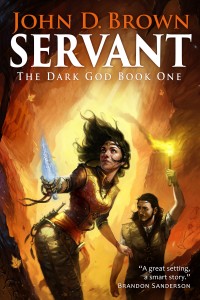
Servant of a Dark God in Paperback, Tuesday, November 2!
For those of you who have been waiting for the cheaper version — Be happy, pre-order the book today! Alternatively, you may vote in the national elections then immediately reward yourself for being such a responsible citizen! Or make someone else happy for Thanksgiving, Christmas, or some pagan solstice ritual with 624 AWARD-WINNING pages of thrilling ACTION, cool MONSTERS, wicked MAGIC, and a Ginzu KNIFE! (okay, so there’s no knife, but the book does feature the most awesome weapons ever; I’m talking about the three living silver spikes called Hag’s Teeth). Whoever gets this book will love you forever*. Book info in the Fiction part of my site.


*tested on a statistically valid sample of gerbils, hamsters, and various other intelligent rodents who all cheered with wild delight at the reading and then asked for more peanuts and crackers

Share

Learn plot, character, scene, and more this Saturday, Oct 9!

Posted in News - updates on books, events, appearances, etc., On Writing  by John Brown on October 4th, 2010

All you Utah and mountain area writers & teachers, or those close enough to travel, I will be presenting and conducting workshops from 9:00 am until 4:30 pm this Saturday, Oct 9th as part of the Autumn Writers Conference sponsored by the American Fork Arts Council and the National Endowment for the Arts.

The sessions I’ll conduct include:

  • Finding and Working With an Agent
  • How to Write a Story That Rocks: First Principles & Story Concept
  • Creating Characters that Rock
  • Plot
  • Writing Scenes: The Basic Units of a Novel

There are four other tracks. Find all the details, including cost and contact info, on the organizer’s site: CalebWarnock.blogspot.com. I’m totally stoked for this. I’ll be sharing what I think are the Pareto factors in each of these areas — things I wish I would have known when I started and would have shaved years off my journey to publication.

A number of other authors will be there including:

  • Annette Lyon (women’s fiction and a new cook book called Chocolate Never Faileth)
  • Josi Kilpack (mystery and suspense)
  • LeAnne Tolley (health and wellness)
  • Scott Livingston (poetry)
  • Caleb Warnock (self-sufficiency)
  • Loraine Scott (mystery)
Share

Interview on Dungeon Crawlers Radio Monday Night, Oct 4!

Posted in News - updates on books, events, appearances, etc.  by John Brown on October 4th, 2010

Malak and Revan of Dungeon Crawlers Radio will be doing a live interview with me tonight on UtahFM at 6:20 PM Mountain time tonight, Oct 4th (that’s 5:20 pm Pacific, 7:20 pm Central, and 8:20 pm Eastern). You can access the show by going to www.DungeonCrawlersRadio.com and clicking on the listen live link. This is going to be fun. Here’s your chance to show up and ask questions! Or submit them early by contacting them via their site. Maybe I’ll reveal how I almost became a cult leader. If you have an iPhone with a blue tooth adapter you can stream it through the phone with the UtahFM app. Contact Dungeon Crawlers Radio for more details.

Share

Tags:

The Key Conditions for Reader Suspense Part 1: Problem

Posted in On Writing  by John Brown on October 1st, 2010

Sometimes it feels like there are a thousand things to remember when writing a story. New writers who make lists of these things soon begin to drown in them. But I’ve come to realize that many of these “rules” don’t matter.

They don’t matter because many ignore the function of story. This makes it impossible to know how and when to apply them, or if they’re even something you should apply in the first place. Furthermore, a good number that do tie back to function often have little impact.

In fact, the more I write, the more I believe the Pareto Principle applies to writing–a few vital factors make up most of the effect. The key is to focus on a limited number of fundamentals. To focus on these things that matter most. The things that produce the biggest bang for the buck.

So what really matters when you’re writing a story?

That all depends on what you’re trying to do. Form follows function.

So what is the function, the objective?

First of all, it’s something that happens in the reader. Readers buy stories because they provide a service, they do something to the reader, guide them into an experience. In this series, I take a look at what I think is one of the core elements of the story experience and identify the Pareto factors for delivering it to the reader.

That story core, or at least a huge part of it, is suspense.

Man goes out and turns on his sprinklers. They hiss to life. He scratches his bum, looks at the rising sun, goes back inside, and nothing more happens.

You want to pay me money for that one? Want to make it into a movie? It’s a story.

Yeah, it’s a story alright, you may say, but who cares?

Okay, so maybe while he’s scratching his bum, a guy with a gun slips in the back. The intruder points the gun at the man’s daughter who is standing by the toaster buttering her bread. She’s a teenager, dressed in cutoffs and hiking boots. The intruder says, “Your father is going to be coming back through that door any time now. You’re going to call him into the kitchen. We’re going to have a chat. You two didn’t finish the business we talked about.”

The girl only has a butter knife, but she grips it tighter, considers that only 13% of shots fired by cops in gunfights hit home. This was drilled into her by her firearms instructor. The guys who are trained only hit 13% of the time. It’s that low even though most gunfights start with the opponents standing only six feet away from each other–the distance between her and Gideon with his gun. That’s what happens when the adrenaline takes over. But Gideon doesn’t look like he’s full of adrenaline. He looks like a man going to a BBQ. So maybe he has a 40% chance with each bullet. That still gives her 60. 

The front door opens. It distracts Gideon for just a moment. The barrel of his gun moves slightly to the left.

It’s not a story yet, but it’s more interesting. And it’s more interesting because that second version generated something the first one never could. What it generated, dear Reader, was a little rise of hope, fear, and curiosity–a little suspense.

After finishing draft 3 of CURSE OF A DARK GOD, I needed a break. So I reviewed my notes of DARK GOD’S GLORY, debriefed the many things I learned this last year about novels and story (and, oh boy, was it a year for learning), wrote up my “Ideal Novel” document, and then began to study structure and suspense. It’s been a wonderful and fruitful month.

I think I’ve found some clarity and solidified a number of Pareto factors for suspense. Let me share my current thoughts on the subject. (Interestingly enough, the Writing Excuses guys just did a podcast on this subject: 5.4: Creating Suspense. You might want to check it out.)

Because form follows function, let’s start with the end in mind.

In the stories we love, the stories we stay up late at night for, the ones for which we pay $25.99 in hardback, the ones we willingly spend hours of our life on, those stories very frequently put the reader into a state of hoping and fearing for a character. This starts as curiosity and quickly moves to sympathy. Very often it builds to an edge-of-your-seat worry that continues up to the end of the novel. At that point the reader experiences a cathartic release.

When we talk about suspense, this is what I believe we’re talking about. And a key thing to remember is that the tension we’re after is not something that’s in the text. It’s something the text builds IN the reader. So you may have massive explosions, deaths, chases, escapes, villains, and all the hordes of hell combine in your story, in the text, but that does not mean the story has dramatic tension. Because dramatic tension is a READER concept. You may have a relatively quite scene where a child is doing nothing more than swinging at a park, but because the reader knows the child molester has just arrived and the park is empty, the scene creates dramatic tension. The girl feels no tension. She’s just swinging away. But the reader’s tension goes through the roof. It’s all about what happens in the READER.

So the question is what key factors of a story guide the reader into this dramatic tension?

Well, we first need to understand what’s involved with this tension. What’s it made of? I came across a lovely *discussion of this last month in David Howard’s How to Build a Great Screenplay and have adapted it to my use. In emotional terms, we HOPE and FEAR for a character. “We don’t know what WILL happen, but we know [or suspect] what MIGHT happen, and therefore feel tension about those possibilities” (p52).

Notice the key ideas:

  • Hope
  • Fear
  • Character
  • Uncertainty

So what makes us hope or fear for someone? What makes us uncertain of an outcome?

I see vital ingredients, key conditions in three of the four parts of story—problem, character, and plot. In this blog I’ll discuss the Pareto factors for suspense I see working in problem. In following posts, I’ll identify those I see in character and plot.

The Nature of the Problem

Form follows function, so what types of problems lead to us hoping and fearing for a character?

When I look back at the stories I love that produce this effect in me, I see three main types of problems. I’ve talked about these before.

Problem Type 1: Danger/Threat

In this type of problem, there’s a danger or threat to some aspect of the character’s happiness that is significant enough that the READER can sympathize.

With these problems we HOPE the character avoids or eliminates the danger, but we FEAR they may not. There are many aspects of happiness that might be threatened or in danger. I’ve listed below those that raise my FEAR and would raise my fear for someone else. I’ve stated them in first person, but you can think about them in third.

1. Life

In these situations my life is in danger or threatened.  People are out to kill me (HUNGER GAMES); I’m going to starve or freeze to death (“TO BUILD A FIRE”); there’s a shark in the water who would like a taste (JAWS).

2. Security & well-being

My security and physical well-being is in danger or threatened. These include all sorts of situations where bullies threaten me with violence or where I might be maimed in some way. Or I begin to lose some vital function—sight, hearing, speech, my ability to think, etc.

3. Relationships

In these situations my inclusion in a group is threatened. My love, friendship, relationship, feeling of belonging or of being valued are endangered. For example, I’m ostracized by a group, shunned, discriminated against. Or maybe my girlfriend begins to look at other men and I fear losing her, or my son and I become estranged and I fear losing him. This can even be a physical separation like in TAKEN (daughter kidnapped for the slave trade) or NOT WITHOUT MY DAUGHTER (daughter kidnapped by husband).

4. Meaningfulness

In these situations my sense of fulfillment of doing something worthwhile is in danger. I’m threatened with a life of drudgery. You can see this at work in the beginning of THE INCREDIBLES where Bob, Mr. Incredible, has to work in a deadening insurance office. But it might be someone whose future or ability to do things that are meaningful to them is being threatened. For example, a boy who desperately wants to play the piano has his piano and is forced to do something else.

5. Freedom

Anything threatening our freedom. It might be slavery or blackmail or government control or a number of other things.

6. Ownership

In these situations my ability to retain and use my possessions is threatened. Any time something precious is stolen from me, my happiness is affected.

7. Other aspects?

These are the main aspects of happiness I’ve identified that seem significant enough to raise fears. If you think you know another, please post a comment.

Problem Type 2: Lack/Opportunity

In this type of problem, a character has a lack of and opportunity for some aspect of happiness that is significant enough that the READER can sympathize. These are often about characters in some kind of hardship. The lacks, hardships, and opportunities all have to do with the same aspects of happiness as listed above. In these situations we HOPE the character is able to fill the lack; we HOPE they will be able to grasp this opportunity for happiness. But we also FEAR they will fail.

If you think about love stories, these are all stories of lack/opportunity. She’s alone, without a lover, or a satisfying and loving relationship, and she meets someone. Suddenly, she has an opportunity for happiness. As readers we immediately began to hope she will find that relationship wonderfulness and fear she might not.

In the movie OCTOBER SKY a young boy lives in a coal mining community. But it’s not his thing. He suddenly gets an opportunity at school to do something with science. This is his ticket to doing something meaningful. We HOPE he doesn’t miss it, but we FEAR he might.

Problem Type 3: Mystery

A character encounters a mystery that is significant enough that the READER can sympathize or feel curiosity about it.

The first two types of problems center on happiness. They raise suspense and sympathy and worry in the reader. This last type of problem centers more on raising curiosity in the reader. We HOPE the character solves the mystery because we want to know the answer as well, but we FEAR they might not.

Very often these types of problem are paired with some aspect of happiness. The vast majority of murder mysteries, cop stories, and courtroom dramas do this. In fact, many happiness problems are paired with mysteries and puzzles.

Problems that are HARD to Solve

Let’s go back up to the objective. We want to HOPE and FEAR for the character. We don’t know what WILL happen but suspect or know what MIGHT and we worry and feel tension about the possibilities. We want to worry, and we want that worry to build to a pitch. We then want to experience a cathartic release.

How will we FEAR if the problem is so easy anybody could fix it? How will we WORRY if the lead has all the odds stacked in his or her favor?  How will we feel UNCERTAIN if we know exactly what’s going to occur?

I can’t worry for Frodo, for example, if all he has to do is cast the naughty ring into the pit of doom that lies on the other side of his street. I can’t worry about a guy finding a girl to love and who will love him, and have that worry build to a sharp edge-of-your-seat point, if all he has to do is proclaim his feelings and the girl immediately rushes to him forever.

The facts are that we won’t feel fear, worry, or uncertainty unless the problem is HARD to solve. I’ll discuss the Pareto factors for making problems hard when I talk about plot.

Problem Intensifiers

Besides being hard, problems need to be urgent. I’ve identified four factors that seem to intensify the nature of the problem: probability, immediacy, significance, and specificity.

1. Probable

It’s one thing to face the one-in-a-gazillion chance that I might be trampled by a herd of elephants when I walk out of the door. It’s quite another to know that the last seven people who walked out of the door were killed by the madman with the AK-47 sitting at the end of the hall.

The higher the probability of the threat or loss of opportunity, the more intense the problem becomes because it’s more likely I’ll lose. No probability and I have nothing to FEAR.

2. Immediate

It’s one thing to know an asteroid will hit the earth and kill us all in 7,000 years. It’s quite another to know it will hit in three days.

The more immediate the problem, the less likely I’ll be able to solve it. The less likely my chances are, the more I’ll WORRY. Give us 2,000 years, and I’m sure we’ll figure out the asteroid thing. Give us three days, and that’s probably cutting it too close. This is why setting up a time limit, a ticking clock or ticking time-bomb, can ratchet up the audience’s tension.  Of course, it has to be a short time limit. You can’t start the bomb ticking, and give the lead 45 years to disarm it.

3. Significant

We talked about this before. It’s one thing to face the kidnapping of my pet spider. It’s quite another to face the kidnapping of my child. Significance increases when more is put at risk.

The more significant the threat or opportunity, the more invested I become. The more I FEAR to lose.

4. Specific

It’s one thing to say that something bad is going to happen. It’s quite another to know that kidnappers are going to cut your finger off with a pair of wire dikes. It’s one thing to have someone say something good will happen (Chinese fortune cookie) and quite another to say your uncle just died and left you a million dollars, but you have to fight your three cousins for it.

The more specific the problem, the easier it is for us to see the specific possibilities and react to them with HOPE and FEAR. Generalities don’t trigger emotions.  Striking snakes do, though. As do garbage disposals that are turned on just when you reach in to get the baby’s pacifier.

Another part of this is to make the threat specific to the hero. It’s one thing to say a lot of people in the United States or Russia or India are going to die. It’s another to say the hero will lose his own child or wife in the event. In fact, the loss of one child can make the problem more intense that the loss of thousands.

This is not to say you can’t write about threats to large groups of people. That’s one of the ways to broaden the scope of the problem and make it more significant. It’s just that problems become more intense the closer they comes to home. Things that threaten us personally, or those we love, raise more fears than those that threaten people we don’t know. A flood raging in the next county is different than the one coming down our street. So in story, the more personal you make the threat to the person we’ve invested in, the more intense the threat will be.

Uncertainty

Supporting all of this hope, fear, and worry is the fact that the reader is uncertain of the outcome. The character must have a chance to solve the problem up until the end, but for no extended period of time can it look like winning or losing is assured, because the moment the reader can predict the ending and the major turns along the way, that’s the moment they will lose interest.

Think about this. It’s the first quarter of a football game, and the score is 64 to 0. Anybody sticking around for that one to play out?

No, you can predict the ending. Why watch? Predictability kills hope, fear, and worry. It kills interest.

So how do we make sure the reader is uncertain of the outcome?

First, as stated before, we make the problem hard to solve. We’ll get into more specifics during the post on plot, but we make the problem harder to solve by giving our characters limitations, putting them into ongoing and continuing troubles, and making them face conflict with their own competing desires, other people in the story, and the setting.

But there’s another ingredient. The second thing we do is introduce surprise. Surprise is one of the vital elements in story making precisely because it makes things unpredictable. It makes hope, fear, worry, and curiosity possible.

There are two forms the surprise takes. The first is surprising or new limitations, troubles, and conflicts. New twists to the problem.

Maybe we’ve seen lots of stories about assassins who need to go behind enemy lines. But what if we add a surprising conflict. What if our character is asked to sneak in and kill his sister? Or his mother? Or his best friend? Or the teacher he loves?

What if our lead is not a highly-skilled CIA operative, but a child who has been trained for this, and not as a suicide bomber? Or a grandmother with no training at all who is forced into the situation?  What if the person she is supposed to kill isn’t in enemy territory but a religious leader or someone in our own government?

Do you see? You simply twist the elements of the problem in new ways. While the situation may be similar, it’s not the exact same thing they’ve seen before, and so it prevents them from predicting how things will unfold. While they suspect what MIGHT happen, then don’t know what WILL happen.

The next type of surprise is to simply introduce a turn into the story the reader cannot foresee. Again, this relies on reader expectation. So the sidekick we’ve lead the reader to trust turns out to be a traitor. The tactic that the reader has seen work so many times in other stories fails right off the bat in your book. In fact, maybe the whole plan fails. The villain finds out about the child assassin in the beginning and when he shows up, they’re waiting.

Surprises give the story vital jolts of life. Set up a problem that has a new twist to it and give us some unexpected twists along the way during the plot.

Developing a Story Problem

Story problems are the engines that make stories go. They define where a story starts and when it ends. They do so because they generate hope, fear, worry, and curiosity. You might have great characters and a fabulous setting, but if your characters don’t face gnarly problems, readers will be unable to hope and fear for them. They will not worry. And they’ll soon tire of waiting for something to happen.

When I’m developing the central problem of my stories, I find the most exciting possibilities when I think of possible threats/dangers, lacks/opportunities, and mysteries. My ideas start to really crackle when I think of ways to make those problems harder, more urgent, and the outcome more uncertain. When I do this, I find I never have to worry about knowing what to write next. The problems beg for scenes.

It’s true that some delightful stories do not promise or deliver suspense and curiosity as their major delights. For example, in many mysteries, readers are not hoping and fearing as much as they are enjoying the character interactions or the humor. But even in those stories, hope, fear, and curiosity play a significant role. They often structure the novel.

The bottom line is that suspense over a character’s fate (hope, fear, and worry) or the answer to an involving question (curiosity) is one of the key things readers come to our stories for. And all that suspense starts with problem. However, it can’t end there because readers won’t worry for just anybody. You have to have characters they can get behind. In the next post in the series, I’ll write about a number of Pareto factors that naturally invest a reader in a character’s fate.

Notes

*These notes might expand. For right now I just want to share the full Howard quote.

“As we’ve seen, what the audience hopes for and what the characters hope for need not be the same thing. The same is true of our fears versus their fears. But how do hope and fear fit into the scheme of storytelling? Hope and fear are about the future. They derive from uncertaintly about future events in the story, future decisions the characters might make, future discoveries or revelations that might be unearthed, future outside forces and how they will influence the journey of the characters. When we discuss hope verusus fear in dramaturgical terms, this uncertainty is a function solely of the audience and its experience [my emphasis]. This is dramatic tension. We hope the man with the cobra in the shoe box won’t open the box; we fear he might and get himself or someone else bitten. We don’t know what will happen, but we know what might happen and therefore feel tension about those possibilities” (How to Build a Great Screenplay, 52).

Parts in the The Key Conditions for Reader Suspense Series

  1. Scene  (coming soon)
  2. Development Tips
Share

Tags: