I’m at the 51% mark with my trim and have cut 10,000 words. Right on target. And I haven’t cut any story, just flab in the writing. Usually when I revise, I add words. I thought I wrote lean, but that’s clearly not the case. Strangely enough, I have to say that I’ve enjoyed every hour of this. I’m loving this edit, improving the flow and immediacy, cutting out redundancies and superflous lines. Who would have thunk?
For those of you who are numbers geeks, here’s a peek at the spreadsheet I’m using to track my trim goals and actuals. “Var” means variance. “CTarget” is the target to cut from the chapter.

Tags: Curse of a dark god
Oh, this feels soooooooo good. Here are the stats.
- 58 chapters
- 205,000 words
- I received the green light midway through April. Finished 27 weeks later.
- Looking at my time records, it took me a total of 345 hours to finish this draft. And the lion’s share was new stuff. This took less time than it normally does for me, but it’s the freaking forth time through and I know the world and characters.
- I averaged about 13 hours per week. It still bothers me I couldn’t get that closer to 20 hours.
- This translates to a rate of about 600 words per hour, and that’s with daily edits, thinking, backtracks. I’m not going to win any speed contest, but at least I’m consistent.
Of course, it took me an additional 105 hours of work to finally get an outline we could agree on. If I add that, it brings my stats down a bit. But, overall, I’m pleased. For those who want to read an excellent article on writing productivity, look at Kevin J. Anderson’s “The Mathematics of Productivity.”
Now I need to take the next two weeks to cut about 10%. And fix the weather stripping on our French doors to keep the hordes of #@!$%! spiders from coming in. Wish me luck.
Note: it bugs me my bullets don’t show up. Some day I’m going to get someone to fix the stylesheet on this website.
Tags: Curse of a dark god
Had a delightful time delivering “Story Lessons from the Hunger Games” at the annual conference for the Utah chapter of RWA up in Park City. Especially enjoyed delivering a sweet dream telegram involving waxed chests
Here’s the PDF as promised: Story Lessons from the Hunger Games RWA 2011
FYI, I’ve added a page linked to my bio in which I reveal all.
I just finished chapter 50 and am heading into the climax sequence. I have only 9 chapters left, and they should go fast. Right now I’m at 170,000 words. I’m going to finish a little over my target word length, but I don’t think it’s anything I can’t edit back down.
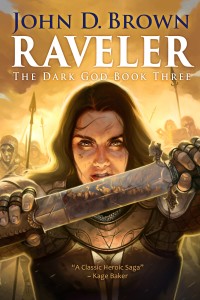
In this book, Talen has to deal with the fact that he was fashioned to be a tool. Sugar gets some kick-butt skills. There’s a little romance. We also get to meet the woodikin, only mentioned in book one, and their wasp lords, as well as a new character named Harnock, who is a sleth blended by Lumen for battle. There are other bit characters: a woman who reminds me of the Wife of Bath and a some sleth from the Old World. The Bone Faces come back in force. And you get to find out what happens to Nettle. Lots of great stuff. I really think those who liked Servant of a Dark God are going to enjoy this.
Oh, yeah. And the Dogmen of Toth, some nasty pieces of work.
Tags: Curse of a dark god
I believe that there are three things you need to know to write stories. The better you know them, the better and more stories you’ll be able to write. Those three things are:
1. What stories do, i.e. what you’re trying to do as an author.
2. The principles of how character, setting, problem, plot, and text work to do those things.
3. The principles of coming up with and developing stories.
About this time last year I wrote my series on the key conditions for creating reader suspense, which went into depth on things 1 and 2. And I’ve written a bunch of other blogs on those topics. This year I’m going to be doing one on the key principles of getting and developing killer story ideas. I’ll be presenting it in a shortened form at this year’s League of Utah Writer’s roundup on Saturday (see my calendar for more details). One neat thing about this series is that I will have a number of other authors illustrate the principles with their own work. When learning this type of stuff, I don’t think we can’t get enough concrete examples. Keep your eyes open. I think it’s going to be a good one.