



Similar Posts
Good Stuff! Extinct, RadioWest, and Ruca’s
I’ve been looking forward to watching Extinct, a brand-new TV series. I watched the pilot with my wife and teenage daughter, and we enjoyed it. I watched the next episode, and then a few days later couldn’t help but binge-watch three more. And I’m happy to report it’s full of good stuff and interesting stories.
First of all, it starts with a killer concept. Aliens invade earth and wipe us out, but that’s been done to death. This story doesn’t start there. This story is set four hundred years in the future after the extinction of the human race, when a small group of humans is revived by an alien civilization.
But this isn’t Star Wars, Star Trek, Blade Runner, Battlestar Glactica or anything like that. It feels more like the TV series Lost or The Maze Runner. The heroes are three humans who have been brought back and are trying to figure out what’s happening and how to survive in a place that’s low tech and is the home to a dangerous band of other humans that were also brought back. They’re dangerous, by the way, because they have been taken over by spores that latch other their nervous system and use their bodies as a host.
This series transports you to a world of cool tech and alien stuff like the sparks that regenerate the humans in pools of water, two interesting drones, and alien ruins and glyphs. But the best part about this isn’t the spectacle of the technology. It’s the stories. There’s suspense and action, but also mystery and a lot of stuff that’s human and warm and, surprisingly enough, thought-provoking.
We try to hold a family night once a week to have fun together and discuss important topics. And I can see us easily watching one of these episodes and finding ourselves in a deep discussion about free will, or the creation, or whether Duncan, one of the skin riders, looks like someone right out of The Hobbit.
I liked episodes one and two, but it was episode three that kicked it into high gear for me. If you liked Lost or The Maze Runner or the series Once Upon a Time, I think you’ll really enjoy this. Right now you can stream the first eight episodes for free from byutv.org/extinct or extinct.tv.
EDIT: I just finished episode 8. I really like this series.
#
Do you like listening to interesting ideas? If so, you will love tuning into RadioWest. It’s a daily program from KUER in Salt Lake City that features hour-long interviews of folks who are experts on some of the most interesting things or have an interesting story to tell.
Doug Fabrizio is the host and has to be the best interviewer on the planet. I love his voice, but it’s his skill in drawing out the fascinating meat of the topic from his guests is what sets him apart. And unlike some interviewers who don’t even read the books they’re talking about, you can see that Fabrizio has done his homework. He’s really thought about what they have to say.
For example, just this last week, I got to listen to compelling interviews of (1) Tom Christofferson, the gay brother of Elder Todd Christofferson, a Mormon apostle, (2) Ben Shapiro, an orthodox Jew who is an up and coming voice on the Right and was recently protested at Berkeley and the University of Utah, and (3) science writer Ben Mezrich who has written a book about the scientists and researchers who are trying to bring back the wooly mammoth.
Week after week, Fabrizio brings amazing people and ideas into my car and home. You can listen to his interviews every morning at 11 a.m. and 8 p.m. on the radio at FM 90.1 (Salt Lake Area), FM 90.5 (Logan and Bear Lake), and FM 88.3 (Randolph and Woodruff). Or you can listen live online at radiowest.kuer.org, which is also where they keep all the recordings so you can catch up on any you miss.
#
New restaurants come and go all the time in Garden City, Utah. Most of them don’t last more than a few seasons. Often this is because they charge lots of money for food that’s really not worth it. So it’s with great delight that I tell you about Ruca’s, a little spot on the block between the city park and Bear Lake Pizza on the main drag.
Not only are the prices reasonable, but the food is delicious. They have sandwiches and other stuff, but we have gone back multiple times for their ebleskivers (AY-bill SKEE-vurs). These are Danish pancakes in the shape of a ball that can be filled with all sorts of stuff. My wife and daughter love the ones filled with peaches and the others filled with Nutella and strawberries. I like the savory ones filled with bacon and cheese with eggs on top.
They’re going to be closing up for the winter, so if you want some great food for a great price, get over there now and enjoy a new delight.
Good Stuff! The actual Christmas story
It’s interesting how many things we’ve added to the accounts we have in the Bible.
For example, nowhere does the Bible say that Mary rode a donkey. Mary might have walked. Or rode in a cart. Or gotten piggy back rides. We don’t know. We do know that there is no donkey mentioned in the record.
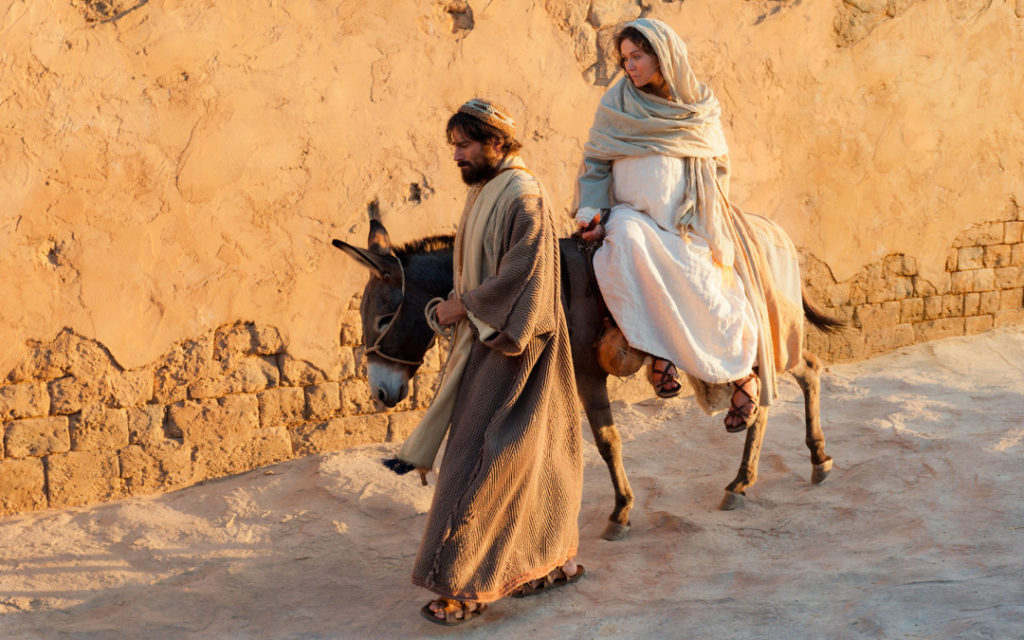
It also doesn’t say she had the child the night they arrived.
It only says she was “great with child” when they made the roughly 80-mile journey from Nazareth to Bethlehem. And that “while they were there” in Bethlehem “the days were accomplished that she should be delivered.”
So she had the baby sometime while they were there. That could have been during the first hour. But it could have also been a week or month later. We just don’t know.
It doesn’t mention anywhere the word stable.
Christ might have been born in a stable, or he might have been born in a cave, or inside the house, or out on the porch, or on the roof (lots of those places had flat roofs where they hung out). We just don’t know. What we do know is that he wasn’t born in a palace. And that they laid him in a manger because there wasn’t any room in the inn. An odd circumstance for a king.
Notice as well that there weren’t multiple inns.
It just says “the inn.” And if you look up that word in the Greek, it’s translated as “guest chamber” in the other spots where it’s used in Luke. So they could have been talking about the one guest room in the house where they were staying. Either way, we don’t have anything that says there was a mean innkeeper who later regretted turning the couple away or that Joseph went door-to-door looking for a place.
We have no record in the account of three wisemen.
It just says “wisemen.” So there might have been two of them. Or twelve. We don’t know. And it appears they came sometime after Jesus had been born because they first saw the star of his birth in the east and only then set out to find him. They might have been coming from Persia, hundreds of miles away. Or they could have been living in Bethphage, a mile to the east of Jerusalem. Either way, they didn’t know they should travel to Bethlehem because it says they went and talked to Herod first, in Jerusalem, and asked “where is he that is born King of the Jews?”
The question freaked Herod out (if you’re the current king, you kind of want to know who else is claiming your throne), and so he gathered all the chief priests and scribes to discuss it, and those guys said the prophecies said it would be Bethlehem. And so Herod met with the wisemen again and told them to go there. And only then did they go down to Bethlehem. So it doesn’t appear the wisemen were there the night of the birth.
There’s no record of camels hanging out with the baby either. Or sheep. Or goats. There’s not a lot there. But what is there is interesting.
Now, I want to go on record stating I have no problem speculating about the event and imagining what it might have been like. I love to do it. Good grief, I write fiction.
In fact, for many years I figured I needed to get in on the Christmas noun gig. You know what I mean. Every year we get heart-warming books about new Christmas nouns. We’ve had Christmas sweaters, Christmas jars, Christmas boxes, Christmas candles, Christmas carols. This year I see there’s one about Christmas fudge and other about a Christmas train. So I figured I’d do one. Mine would be about the Christmas rat. A little fellow who decided to snuggle up with the babe instead of giving him a nibble. One of these days I will get that hungry rat story written.
In the meantime, while there’s a lot of good stuff we’ve added to make the event special, it’s also nice to know what the record actually does say. Whether you’re Christian or not, it’s helpful when dealing with others to know what was recorded about this event that is so significant to the largest religion in the world.
And so the last bit of good stuff I recommend this month are the two brief accounts we have. The first one is in Matthew 2:1-16 and tells the story of the wisemen. The other is in Luke 2:1-20 and features some shepherds.
Merry Christmas!
The Drowned Cities by Paolo Bacigalupi
 I just finished The Drowned Cities by Paolo Bacigalupi, and, holy cow, folks—this story rocked.
It’s set in the future in the area around Washington D.C. which is the titular drowned cities. They’re drowned because the climate has gotten warmer, the seas have risen, and D.C. is half under water, permananetly flooded. It’s more like Georgia or Florida—gators, kudzu, the works. But this is not another dumb book about global warming. If it were, I wouldn’t be writing this.
No, the United States has fallen apart. Up north there’s some alliance with money and power and the ability to keep those in the Drowned Cities out. South, who knows? West? Don’t know. But right around D.C. everything has gone to hell.
It’s like Mogadishu, Somalia in the 1990’s (Blackhawk Down) with warlords fighting each other, tearing the place apart.
It’s like Sierra Leone at the end of that decade with different factions butchering locals and forcing kids to fight as soldiers.
Except instead of the U.S. or Europe or the U-freaking-N sending in peacekeepers to stabilize the situation, it’s China. And just like the U.S. in Somalia, the warlords send the Chinese peacekeepers packing. And so now it’s just chaos.
Talk about a setting for a story. But Bacigalupi doesn’t stop there. He adds in genetically modified creatures. He starts the book with one named Tool. A creature that’s got the DNA of humans, mastiffs, tigers, reptiles and who knows what else all combined to make him smarter and stronger than humans ever could be—a monster that’s the ultimate killer, the ultimate soldier, the ultimate war machine. One that was bred to submit to a master, but something went wrong with Tool. And he was able to break free of that bond.
Tool is trying to escape prison and death. But as mighty as he is, he’s weak and injured. And then two kids from a village run into him while in the jungle. He knows they’re going to reveal his whereabouts to the warlord searching for him. In his weakened state, Tool is only able to grab the small boy named Mouse.
Mahlia, the girl, promises to bring medicine if Tool will only spare the boy. He knows she’s lying.
And so starts a rich tale of the monster, the boy, and the girl: a tale that is filled with friendship, triumph, loss, heroism, cowardice, and earthy sci-fi coolness all set in the midst of a guerilla war. The beginning sucks you in. The ending leaves you breathless. Along the way you get to see into the character of all three plus some of the bad guys. In the end you get a story about sacrifice and love.
If you liked A Long Way Gone, Ishmael Beah’s memoir of his time as a child solider in Africa; if you liked The Hunger Games, and not primarily for the romance; if you like person in jeopardy fiction or war flicks where a small group has to fight for its life, I think you will love this book.
This is the second book set in the same world. The first was Ship Breaker. Tool, one of the most interesting characters I’ve come across, is in that one too. But you don’t need to read that to enjoy this. And I wouldn’t put this read off to do so. Go give The Drowned Cities a try. Three or four pages in, I suspect you’ll be completely lost in the wondrous tale.
Awakening by Christy Dorrity

Art is a huge part of what draws me to science fiction and fantasy. I still have the Hildebrant LOTR calendars I got back in the early eighties.
On the web you can browse awesome work on DeviantArt.com and CGHub.com. But something that’s been around for much longer is Spectrum: The Best in Contemporary Fantastic Art. It’s an art annual released each year that highlights the best art produced that year in Fantasy, Science Fiction, Horror, and the Surreal.
This year will mark the 21st year of publication. Spectrum has become the broadest distributed art annual in the world. Having art included in Spectrum is top honors for artists around the globe.
So why am I telling you this?
Well, Devon Dorrity, the guy who helped me pull together my covers, not only had his sculpture “Queen of the Seas” included in a past annual, but he’s just won a spot in this year’s annual with the cover he created for his wife’s book, Awakening. It’s a big honor.
Here’s the description of how he put it together.
For the book cover for Awakening by Christy Dorrity, Devon Dorrity selected the cover model, Shelbilee Lee, from hundreds of local models. Jason Morrison, a photographer friend, was hired to do the photoshoot. Devon purchased the wig, fingernails, and props from Amazon. Then Dennis Dorrity, Devon’s brother, did an illustration of the photo selected from the photoshoot. Devon then composited the illustration and the photo together blending the two to emphasize the best of both pieces. After applying various effects and custom color, the piece was finished.
After the book’s publication, Devon submitted the cover to Spectrum with Dennis Dorrity listed as the Artist. Dennis did the illustration that plays such a heavy role in the finished piece. Devon was listed as the Art Director/Designer. Spectrum announced in the end of March that the Awakening book cover was selected for inclusion in The annual. Spectrum 21 will be released in November 2014.
Awakening: Book One of The Geis is itself a clean young adult fantasy filled with Celtic mythology, magic, romance, and mystery. And it’s been getting great reviews.
“Dorrity invites her readers to a céilí that will quicken the pulse of anyone with Ireland in their blood! AWAKENING will draw you deep into the mysteries of the Celtic worldview—and leave you wanting more of McKayla and her fascinating Aunt Avril!”
– KERSTEN HAMILTON, author of Tyger Tyger and the Goblin Wars books“I thoroughly enjoyed AWAKENING, a captivating and unique debut novel that creatively integrates Irish dance.”
– CHRIS NAISH, Riverdance member and Creative Director of Fusion Fighters Irish dancers.5 Stars! “AWAKENING is an exciting mashup of fantasy, action-adventure, and mystery, with a touch of romance thrown in for good measure.”
– KATE MCCURRY, top 100 Amazon reviewerHow many authors do you know who have unlocked the achievement of having someone from Riverdance plug your book? Awakening right now is free. If you like YA fantasy with a bit of romance, this is the perfect time to give this new author a go.
You want your kids to succeed in school? There’s one thing you can do…
Did you know that there is one thing that kids can do outside of school that’s been proven, over and over, to lead to them doing significantly better in all other subjects?
And I mean all subjects. Math, history, science, criminology, psychology—you name it.
There’s one thing, and numerous research studies have proven it, that kids do that leads to them getting better jobs later in life.
This one thing, proven by research, leads them to grow up to make more money.
And it doesn’t matter if they start in a rich or poor family. This one thing leads them to greater opportunity. Over and over again.
It’s a thing that kids actually can learn to love. For some it becomes as delicious as eating ice cream.
The kids are back in school. Parents want them to do well. They want them to succeed. How wonderful that there’s one thing that parents can focus on that will so dramatically change their child’s life.
And it doesn’t take long. Even just twenty minutes per day of this activity can change everything.
Twenty minutes.
Is there a parent anywhere that can’t find twenty minutes?
So what is this one thing?
Reading for pleasure.
Notice I didn’t say reading for academic purposes. I didn’t say reading to finish homework. I said reading for pleasure. For the enjoyment it brings.
And it doesn’t matter what the subject matter is. It can be fiction—fantasy, love stories, horror, action. It can be non-fiction—like material on bugs, robots, horses, motocross. It can be fairy stories or funny anecdotes. It can be short or long. The key is that they’re reading for pleasure.
I know some of you might be saying, “But John, my kid doesn’t like to read.”
That’s okay. You can change that.
If you want to find out how to help your child learn to enjoy reading, let me recommend Raising Kids Who Read: What Parents and Teachers Can Do by Daniel T. Willingham, a professor at the University of Virginia whose research has focused on the brain and learning. In the book, Willingham debunks the myths about literary instruction and provides practical, engaging, research-based tips for sharing the joy of reading with kids of all ages.
You can get a used copy for $13 bucks on Amazon.
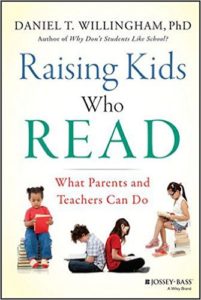
While you’re waiting for the book to come, here are some things you can do start doing right now to help your child read for pleasure.
First, start reading something fun or interesting with or to them every day. For little kids, this can be picture books. For older kids, this can be anything–an article from a magazine, funny stories online, or books large and small. If you want to start with a joke book, that’s okay. If you want to start by listening to a book on tape, that’s great too.
Wait a minute? A book on tape? Isn’t that cheating?
No.
There are four keys to helping your child read for pleasure. They need to learn to:
- Decode the sounds letters make.
- Comprehend what’s meant, which is driven by their general knowledge of the subject they’re reading about.
- Enjoy reading.
- Identify themselves as a person who likes to read books
When you listen to a book on tape, you’re doing numbers 2-4.
Remember: the goal is not to improve the child. It’s not to get them a better job ten years from now. It’s not to make them wealthy. It’s to simply help them enjoy reading. Because once they enjoy reading, once reading for pleasure is something they see as one of the things they do, they will begin to read more and more. And as they read, they become better at reading, which leads to more enjoyment, which leads to more reading. Which leads to all of those other awesome benefits. It’s a virtuous cycle.
So the first thing you need to do is simply start having a good time reading with them. You can read to them at bedtime, after dinner, on weekends. You can have them read articles to you while you’re making dinner or washing the dishes. You can have them read to your or themselves while you’re on the road driving somewhere.
You can make a rule that they have to read with you for twenty minutes before they go play with friends or watch TV or play video games.
And above all, you need to let your child’s interests drive most of the topics you read about. If they want to read about spiders and dinosaurs, then read about spiders and dinosaurs. If they want to read horror stories, then read horror. If they’re into skiing or horses or guns, then help them find interesting stuff on the topics they’re already interested in. And if they don’t like a book, teach them they can abandon it and go find another.
And if you yourself are not someone who reads for pleasure, well, now’s the time to start. You can make reading for pleasure something your family does, just like families make enjoying boating or hunting or riding horses or eating Mexican food part of what they do.
It’s never too late to start.
And seeing that this is the one thing that has such an impact on your child’s success, is there really anything else that would be a better use of those twenty minutes per day?
Reading for pleasure—who knew that having a great time could have so many wonderful effects? Start today. Don’t wait.
It might take a little work. You and your child might run into a few unpleasant spots. But that’s true of anything. How many times do kids fall when learning to water ski or snow ski? How many times do they experience something unpleasant when practicing football or basketball or volleyball?
So start right now. Figure out a time with your child. And begin learning to read for pleasure.
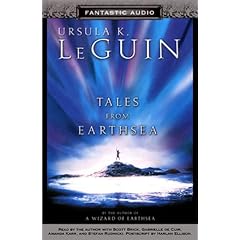
Tales From Earthsea
When I was in 7th grade I read Tolkien’s The Lord of the Rings trilogy. Of course, I wasn’t the sharpest literary tack back then, and so great sections of The Two Towers and The Return of the King went over my head and, therefore, bored me. But, with the help of the Hildenbrant calendars, enough came through to thrill. I wept at the events in the mines of Moria with Gandalf, geeked out over the elves, orcs, and Nazgul, was fascinated with the Ents and wizards, and generally wanted to stay in that world forever.
When I finished the trilogy, I mourned–the dream was over. I read Smith of Wootton Major and Farmer Giles of Ham. Both were delightful, but neither was the same as LOTR. Then I saw The Silmarillion. It had a cool cover, a map.
Oh, joy! I bought it and took it home.
Alas, that book was about as much fun as reading a ten-pounder on the history of baroque cornices. I tried mightily to push through, but I don’t think I was able to finish more than 15 pages total from all the sections. So I mourned again, and then, still feeling the loss, went looking for something else that might whisk me away.
One of those whisking stories was Ursula LeGuin’s A Wizard of Earthsea. Of course, the fact that there was a wizard in it was important, but as equally delightful to my then puny literary prowess, was that the story was a slim thing. As were its two companions The Tombs of Atuan and The Farthest Shore.
Here’s the cover the drew me in so long ago.
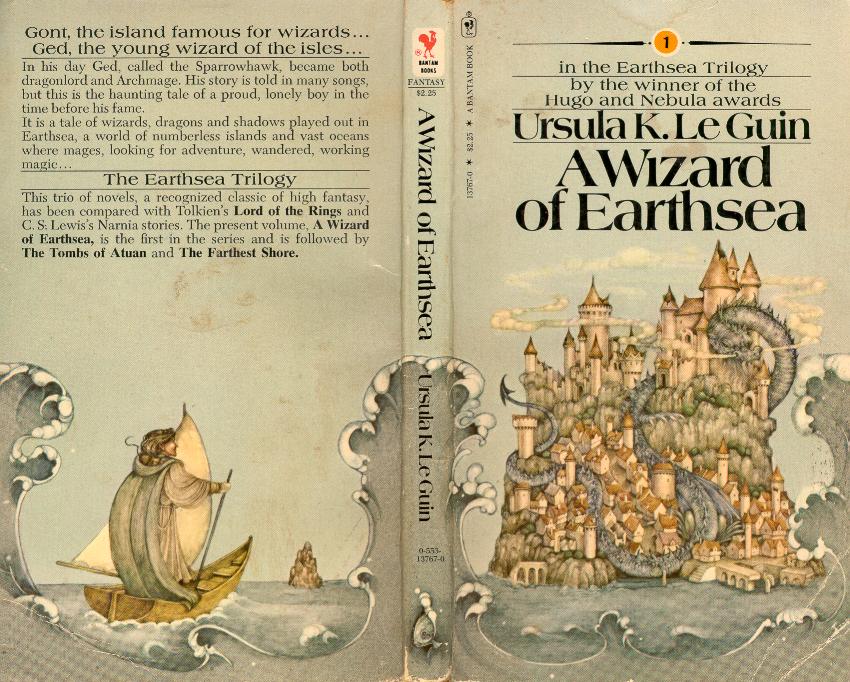
I relished all three and moved on to other stories.
Time passed and I forgot about LeGuin. Almost 10 years later I was newly married. My wonderful new wife started reading to me as we’d drive. And on one of the three-hour drives to her parents, she pulled out this little book and began to read.
It was A Wizard of Earthsea! And it was just as marvelous the second time with a bigger brain as it was the first time with a smaller one. In fact, Nellie’s reading to me was so enjoyable I slowed down to 40 mph so I could extend the 3-hour drive. Of course, she quickly caught on to my scheme, shut the book, and told me she wouldn’t read another word unless I drove 65 mph, at the very least.
What can a guy do? I kept it at 65 (well, 60) and joyed in the wonderfulness of a new wife who would read aloud to me (you mean this model reads, too?!), the night and the stars spread above those lonely Utah and Wyoming roads, and the amazing story unfolding before me.
And this is the cover of the one my wife read to me.
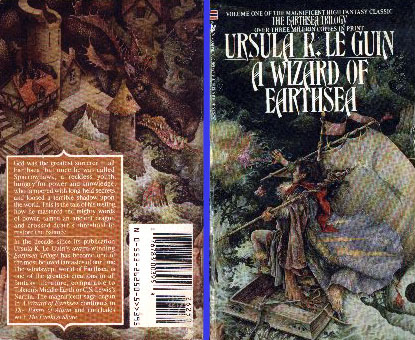
We read all three to each other and moved onto other stories.
More than 15 years passed and I’d mostly forgotten LeGuin (I really never could get into her Hainish stuff). I was in the library looking for some good audio. And there on the shelf stood Tales from Earthsea by Ursual LeGuin.
Just a little slim container of cassettes. Why not? I thought.
Holy heroes, Batman—it was gold. LeGuin’s a master of building that feel: the wonder of fantasy, the mystery of things long forgotten or rumored to exist, the pull of learning arcane powers. I loved every minute of it (well, except for the slogging first four pages of backstory, but get through that, which isn’t too bad with Karr’s reading, and you’re into the kingdom). The first story, “The Finder,” read by Amanda Karr was incredible. It takes us back to how Roke became was it was in the first trilogy. But the delights do not end there. Four more stories follow.
I liked them all so much, I just checked the audiobook out again so I could listen a second time. And, it appears, LeGuin was busy in my absence because she has more Earthsea than this.
• A Wizard of Earthsea, 1968
• The Tombs of Atuan, 1971
• The Farthest Shore, 1972 (Winner of the National Book Award)
• Tehanu: The Last Book of Earthsea, 1990 (Winner of the Nebula Award)
• Tales From Eathersea, 2001 (a collection of short stories)
• The Other Wind, 2001I just got the last two from Amazon. I can’t wait to enter into LeGuin’s magic spell yet again.